








How to Tailor Your Resume for Each Job Without Starting From Scratch
 August 20, 2026

How to Tailor Your Resume for Each Job Without Starting From Scratch
People hear “customize your resume” and imagine a full rewrite every time they click Apply. That sounds noble. It is also why they stop doing it after five applications and go back to sending one generic file.
Tailoring is not rewriting your biography. It is choosing which true things to put first. If you keep a master resume, a single application can take 15 to 25 minutes and still look like you meant to apply to that company.
This is a method you can repeat until it is boring, which is the goal. Boring processes get used.
Keep a Master Resume That Is Allowed to Be Too Long
The master file is for you, not for them. It can be three pages. It can include extra bullets, old projects, classes, and metrics you might need later.
When a posting wants something you did two jobs ago, you should not have to remember it from a cold start. You should be able to copy it forward.
Update the master when you finish a project, ship a result, or learn a tool. Job search you is always in a hurry. Employed you has better access to the facts.
Read the Posting Like an Editor, Not Like a Fan
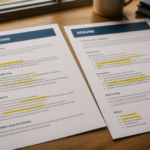
Print it or copy it into a document. Highlight three kinds of language:
Tools and systems
Outcomes they care about, such as retention, speed, revenue, safety, compliance
Repeated phrases for the kind of person they want: cross-functional, on-call, customer-facing, analytical
Then highlight the must-haves versus the nice-to-haves. Must-haves are the lines that would get a recruiter to reject you if missing: a license, a year count that is clearly a hard floor, a shift, a location, a language.
If you fail a true must-have, do not tailor. Skip the job or apply only if you have a fair adjacent case and the posting is loosely written. Tailoring cannot invent a nursing license.
Build a Working Copy, Never Edit the Master Into a One-Off
Save a version named for the company and role. Work there. If you edit the master into a specific posting, you will lose bullets you needed for the next one.
In the working copy, do four moves:
Adjust the summary so the first line matches the lane of the job
Reorder or trim the skills list so the posting’s tools appear, if true
Promote matching bullets to the top of each relevant job
Demote or delete bullets that pull attention toward the wrong story
That is tailoring. You might also rename a projects section to match their language: “Selected implementations” instead of “Projects,” if that is accurate.
Mirror Language Without Becoming a Parrot
If they say “stakeholder communication” and you wrote “worked with other departments,” change the phrase if it is true. If they say “SQL” and you wrote “databases,” be specific.
Do not paste whole sentences from the job description into your summary. Readers notice. It feels like a chatbot wearing your name.
A good test: would you say this sentence in an interview without looking at the posting? If not, it is not yet your language.
Use the Order of Information as Your Main Tool
You cannot change what happened in 2021. You can change what they see first in 2026.
If the current job is a weak match and an older job is a strong match, give the older job more bullets and a slightly fuller heading. You can even add a short “Relevant experience” grouping, as long as dates stay visible.
If a project is more relevant than a job duty, put the project in a dedicated section near the top, especially for career changers and technical applicants.
Order is emphasis. Emphasis is tailoring.
What You Should Not Tailor
Do not change employers. Do not change dates. Do not change titles into something you were not. Do not add tools you used once in a workshop and forgot.
Do not create 12 personality versions of yourself that you cannot defend on a call. The document should still sound like one person.
A 20-Minute Checklist
Minute 1–4: Highlight the posting.
Minute 5–8: Rewrite the summary’s first two lines.
Minute 9–14: Edit skills and the top six bullets across the resume.
Minute 15–18: Add or restore one proof item from the master file if a requirement is sitting unanswered.
Minute 19–20: Read the top third out loud. Fix tone. Export PDF. Name the file with your name and, if you like, the role.
If it is taking two hours, you are rewriting, not tailoring. Stop and return to the four moves.
When the Job Is a Stretch
Stretch roles still get a tailored resume, but the summary should not pretend you already have the title. Show the nearby proof and the direction.
“Senior-ready operations lead” is a claim. “Operations manager targeting multi-site roles after running a 70-person flagship store” is a story. Stretch with evidence. Do not stretch with adjectives.
Track What You Sent
Keep a simple log: company, role, date, which version of the resume, which bullets you featured. When you get an interview, you need to remember which story they saw. When you get silence, you can notice patterns. Maybe your operations bullets are landing and your “open to anything” summary is not.
Without a log, tailoring becomes folklore. With a log, it becomes a craft you can improve.
Cover Letters and Applications Forms
Tailoring the resume does not mean you skip the form. Many portals ignore your PDF and parse text boxes. Paste real, complete answers. Do not write “see resume” in a skills field.
A short cover letter can name the match in sentences the resume cannot: why this company, why this moment. Keep it from repeating the bullets word for word. The letter is motive and fit. The resume is proof.
What Success Looks Like
Success is not a unique novel for every URL. Success is a reader who feels, in 20 seconds, that this file was aimed at them.
They see their tools. They see their problems in your results. They see a person who read the posting.
That feeling is worth 20 minutes. It is not worth a weekend of perfectionism. Use the master file. Make the four moves. Send it while the role is still open.
A Note on Volume Versus Aim
People ask how many applications they should send in a week. The better question is how many tailored applications they can send without the quality falling apart. Ten generic files is not a strategy. Four aimed files plus a log is closer to one.
If a role is a near-perfect match, spend the full 25 minutes. If it is a loose match, either skip it or do a light tailor: summary and skills only. Do not spend an hour decorating a long-shot. Do not spend two minutes on a role you actually want.
Protect your energy for the applications that deserve it. That is also tailoring: choosing where to spend attention.
The people who get interviews are often not the people with the most ornate resumes. They are the people who applied to the right jobs with a document that matched. Tailoring is how you join them without burning out by Friday.